|

FREDERIC B. STRESAU AWARD
The ASLA Florida Design Awards Program encourages the advancement, expansion, and recognition of the Landscape Architecture profession by honoring projects that blend environmental and artistic principles that emphasize beauty, function, and the sustainability.
The Frederic B. Stresau Award is named in honor of Fred Stresau, who is considered by many to be the father of Florida Landscape Architecture. The award is bestowed annually by the ASLA Florida jury to the professional award of excellence recipient that best exhibits innovation and design excellence. These works are truly exceptional and collectively contribute to enhance our body of knowledge.
2026 Recipient:
Jinsheng Square Renewal, Revitalization of Historic Areas in Guangzhou
Guangzhou S.P.I Design Co.
About the Project: Jinsheng Square, located in the Yongqing Fang historic neighborhood, Guangzhou, had previously been a thriving cultural hub before falling into obscurity. Its revitalization was catalyzed by the restoration of the Jinsheng Grand Theater. By meticulously identifying design objectives and extracting key elements, the renovation preserves the historical fabric while introducing new vitality through micro-renovation techniques. The circulation was also reorganized to enhance connectivity and spacial permeability. This revitalized urban public space not only enhances residents’ quality of life but also maximizes commercial vitality, achieving this by integrating captivating historic buildings with traditional and folk activities. |
2025 Recipient: La Sirene | CLAD Landscape Architecture & Design |
About the Project: Tucked away on a quiet island in vibrant Miami, La Sirene is a small, private garden with a large environmental impact. Designed to manage stormwater runoff, utilizing locally sourced materials, and hosting pollinator-friendly habitats, this residential garden is rooted in thoughtful design. This property taps into local history, from family heirloom art pieces to the natural ecology of South Florida. The project was designed around the idea of careful curation and intentionality, creating spaces for both humans and wildlife alike. Through preservation of existing tree canopy, habitat design, and thoughtful material selection, La Sirene is an immersive tropical oasis that begs the user to get lost in. |
2024 Recipient: Cuartel de Ballajá Green Roof | ECo |
About the Project: This former Spanish Army Barracks (1850’s), and its roof, have brought new life to the colonial city. First built in 2010, partially destroyed by Hurricane María (2017), redesigned in 2018, and rebuilt in 2021, the Cuartel de Ballajá Green Roof stands as a 24,000 square-foot symbol of resilience, recovery, and reclamation of a city and a culture that refuses to succumb to the recurring embattlement of a changing climate, both environmental and political. With few resources, technical difficulties, and a limited budget, this project adds a new urban public space, addresses climate, energy and environmental concerns, re-envisions the historical artifact, and provides a new platform from which to view and re-learn the immediate and far context. |
2023 Recipient: The Bay: “One Park for All” in Sarasota | Agency Landscape + Planning |
About the Project: A compelling first phase following an unprecedented and inclusive master planning process, The Bay is the City of Sarasota’s first signature waterfront park. Located where the city’s iconic Boulevard of the Arts meets the Sarasota Bay, The Bay is a living demonstration of 21st century sustainability principles, a memorable community gateway to and on the water, and, in its craft, a loving reflection of Sarasota’s unique natural and cultural context. This 10-acre park brings together active, changing spaces for Sarasota’s diverse community, regional trail and mobility connections, and intimate places of deep nature immersion within the City. |
2022 Recipient: Bringing Community Back to Fort Lauderdale Beach | EDSA - Fort Lauderdale |
About the Project: The primary purpose of the Las Olas Corridor Improvement Plan was to give space back to the community in a healthy, sustainable way. By consolidating three surface lots into one parking structure, almost nine and a half acres of waterfront real estate was converted into active public realm. Activation through city events, a park, waterfront promenade, and flexible open spaces now provide residents and tourists with opportunities for public engagement. Fully native gardens were planted in the park, creating a sanctuary for pollinator and animal species, while stormwater treatment was significantly improved by harvesting rainwater for public restrooms and allowing natural percolation. This project also looked outside the parcel boundaries and relocated almost 100 trees and palms to other parks and streetscapes, benefiting several districts throughout the city. From an environmental policy perspective, the dual board lighting fixtures are the first to be approved by a local environmental protection agency and a wildlife conservation agency on a timeclock, which balances public use with turtle nesting sites– bringing both communities back to Fort Lauderdale Beach. |
2021 Recipient: The Captain Leonard Destin Park | Wood+Partners & Kimley Horn |
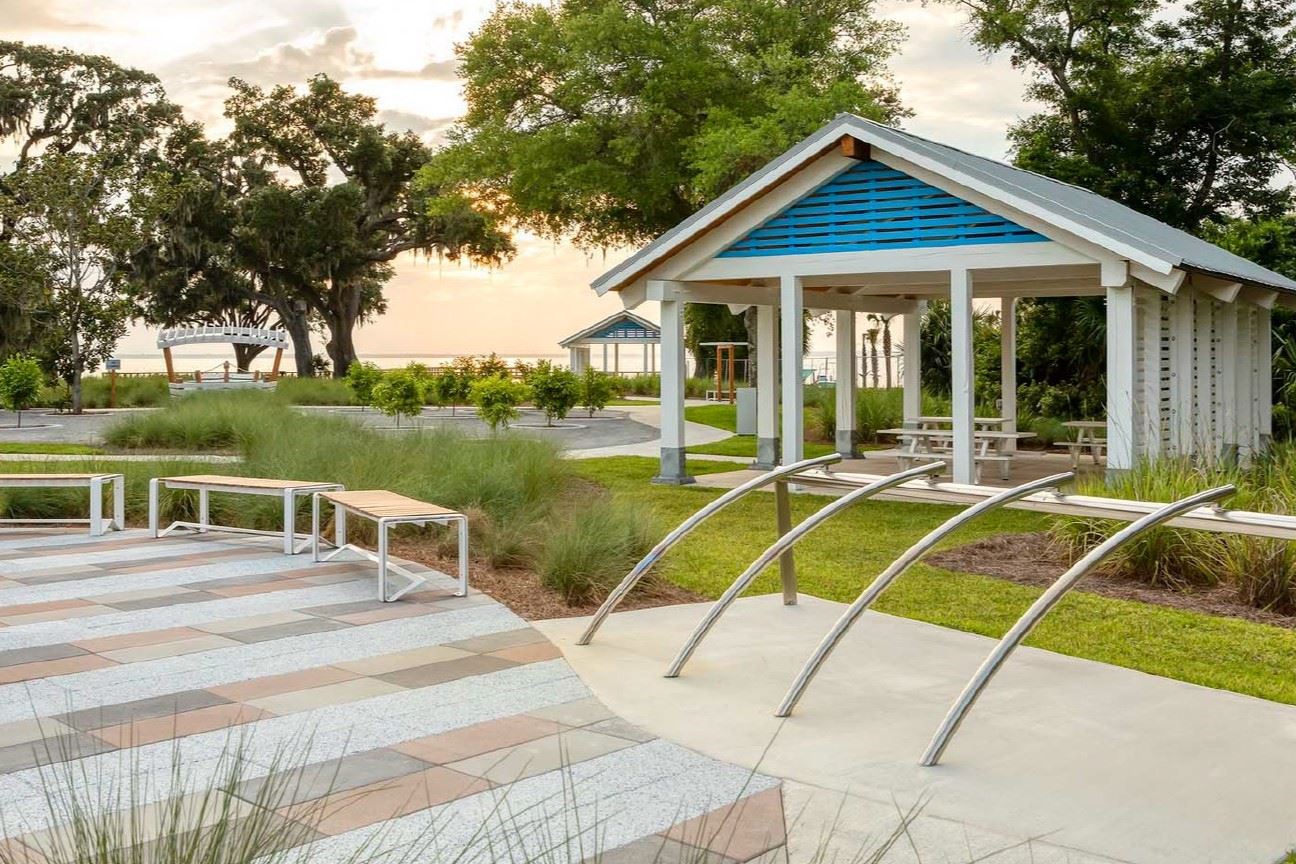
About the Project: In April 2010, the Deepwater Horizon oil rig exploded in the Gulf of Mexico— an environmental disaster known as the worst in the nation’s history. British Petroleum paid $17 billion to fund restoration and land protection throughout the Gulf region. A portion of this funding was responsible for the creation of Captain Leonard Destin Park. Before the park, the area lacked public entry for residents to access water, play, or socialize on the waterfront. This park includes a boardwalk, paddle-craft launch, fishing pier, playground, splash pad feature, and beach access. The vision for the park preserves and protects the natural features of the site, including the existing heron rookery, while embracing the historical significance as Captain Leonard Destin’s homestead and providing resilient solutions. Nestled in the residential fabric of Destin, Florida, the park represents a lifestyle that revolves around access to the Choctawhatchee Bay. Materials are familiar while the patterns and spaces reflect the rhythm of tidal currents. The park design translates the historic and natural features into a contemporary environment for social gathering. |
|